




Quick Answer
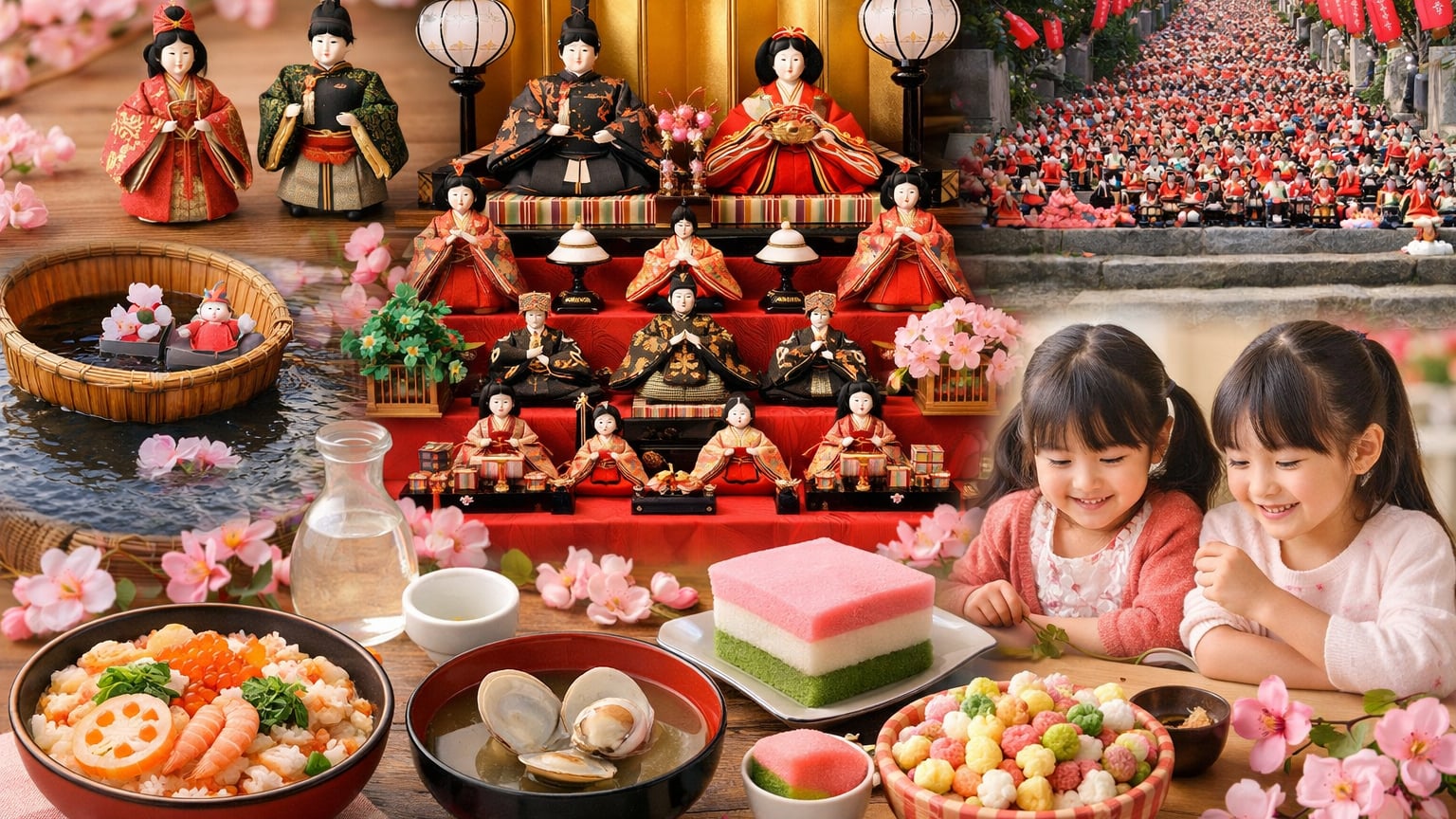
Hinamatsuri, celebrated on March 3rd, is a traditional Japanese festival praying for the healthy growth of girls. Families display tiered hina dolls, eat symbolic seasonal foods, and enjoy spring sweets. It is not a national holiday—businesses and schools stay open—but the celebration is widespread across Japan. This guide covers the meaning behind the dolls, what families eat, regional differences, and how to experience Hinamatsuri as a foreigner in Japan.
What Is Hinamatsuri?
Hinamatsuri (雛祭り, "Doll's Festival") falls on March 3rd and is one of five traditional seasonal festivals in Japan known as sekku (節句). The March celebration is specifically called Joshi no Sekku (上巳の節句)—the Upper Snake Festival—referring to the first Day of the Snake in the third lunar month.
Despite being called "Girls' Day," Hinamatsuri is fundamentally a family celebration. It is less of a public festival and more of a home-centered event where families—especially those with young daughters—display ornate doll sets, prepare seasonal meals, and enjoy the arrival of spring. Families without daughters also commonly observe the day in a lighter way.
📌 Hinamatsuri is not a national holiday. Banks, offices, and schools remain open on March 3rd.
Where Did Hinamatsuri Come From?
Hinamatsuri's roots date back to Heian-period court rituals (794–1185 CE) when paper or straw dolls were used to absorb misfortune and illness from a person—a concept called hitogata (人形, "human-shaped substitute"). These figures were then cast into rivers or the sea in a ritual called nagashi-bina (流し雛, "floating dolls"), believed to carry bad luck away with the current.
Over time, the dolls became too elaborate to discard, and the practice shifted from disposal to display. By the Edo period (1603–1868), elaborate hina doll sets had become a popular tradition across social classes.
The peach blossom (桃の花, momo no hana) displayed alongside hina dolls is not just seasonal decoration. In Japanese tradition, peach blossoms are believed to ward off evil—momo (peach) being associated with the expulsion of bad spirits since ancient times. The bloom season also naturally overlaps with early March.
📌 Some regions still hold nagashi-bina ceremonies near rivers or the coast. These are rare but striking to watch if you happen to be nearby in late February or early March.
What Do the Hina Dolls Represent?
A full hina display (hina kazari, 雛飾り) can feature up to seven tiers of dolls, each representing members of an ancient imperial court.
- Dolls
- Male hina & female hina (dairi-bina, 内裏雛)
- Represents
- Emperor and Empress of the court
- Dolls
- Sannin kanjo (三人官女)
- Represents
- Three ladies-in-waiting
- Dolls
- Gonin hayashi (五人囃子)
- Represents
- Five court musicians
- Dolls
- Ministers, guards, servants, furniture
- Represents
- Supporting court members
| Tier | Dolls | Represents |
|---|---|---|
| 1st (top) | Male hina & female hina (dairi-bina, 内裏雛) | Emperor and Empress of the court |
| 2nd | Sannin kanjo (三人官女) | Three ladies-in-waiting |
| 3rd | Gonin hayashi (五人囃子) | Five court musicians |
| 4th–7th | Ministers, guards, servants, furniture | Supporting court members |
📌 The pair at the top are called dairi-bina (内裏雛, also shinno-bina). In everyday speech, the male figure is commonly called "Odairi-sama" and the female "Ohina-sama."
Full seven-tier sets are expensive and require significant space. In modern homes, many families opt for a compact two-tier set or even tachi-bina (立ち雛)—standing-pose figures that occupy almost no room. The trend toward smaller displays reflects Japan's housing reality, not a decline in the tradition.
AdFor a space-saving compact hina display.Osaka Choseido compact hina doll set
📌 A personal impression: In the 1990s, many families made a point of putting up a proper hina display. Today—shaped by rising costs and smaller living spaces—the tradition has often simplified to the point where the occasion can feel more symbolic than lived. That said, gathering with family over seasonal food, however simply, still counts as marking the day.
When Are the Dolls Put Up and Taken Down?
Dolls are typically displayed from mid to late February and taken down shortly after March 3rd. A well-known folk belief says that leaving dolls up too long after March 3rd will delay a daughter's marriage. Most modern families treat this as a charming superstition rather than a firm rule—but most do tidy up within a week or two after the festival.
What Foods Are Part of Hinamatsuri?
Food is an essential part of the celebration, and each dish carries symbolic meaning:
- Meaning (common interpretation)
- Scattered sushi; shrimp = long life, lotus root = clear future, beans = diligence
- Meaning (common interpretation)
- Clear clam soup; clam shells pair only with their exact match, symbolizing a faithful marriage
- Meaning (common interpretation)
- Diamond-shaped layered mochi in pink, white, and green; one interpretation: health, purity, and new life
- Meaning (common interpretation)
- Puffed rice crackers in pastel colors; sold at every convenience store during the season
- Meaning (common interpretation)
- Sweet white sake or sweet rice drink
| Food | Meaning (common interpretation) |
|---|---|
| Chirashi-zushi (ちらし寿司) | Scattered sushi; shrimp = long life, lotus root = clear future, beans = diligence |
| Hamaguri no osuimono (はまぐりのお吸い物) | Clear clam soup; clam shells pair only with their exact match, symbolizing a faithful marriage |
| Hishi-mochi (菱餅) | Diamond-shaped layered mochi in pink, white, and green; one interpretation: health, purity, and new life |
| Hina-arare (ひなあられ) | Puffed rice crackers in pastel colors; sold at every convenience store during the season |
| Shirozake / Amazake (白酒 / 甘酒) | Sweet white sake or sweet rice drink |
💰 Festive chirashi-zushi sets and seasonal wagashi appear in supermarkets and department store basement food halls (depachika) from mid-February through March 3rd—a convenient and affordable way to participate.
⚠️ Shirozake contains alcohol. Amazake made from rice koji is non-alcoholic, while amazake made from sake lees contains alcohol. Check the label or ask if you are ordering for children.
AdSeasonal hina-arare can be ordered online.Hina-arare (Hinamatsuri rice crackers)
Does Hinamatsuri Look Different by Region?
Yes, in two notable ways.
Doll orientation (Kanto vs. Kansai)
In the standard modern arrangement common in eastern Japan (Kanto), the male figure sits on the left from the viewer's perspective and the female on the right. In the traditional Kyoto-style arrangement (Kansai, kyo-bina), the positions are reversed: the male figure is on the right from the viewer's perspective. This difference comes from differing interpretations of imperial court ceremonial seating. Both are correct within their regional traditions.
Hina-arare flavor
In the Kanto region (Tokyo area), hina-arare tend to be sweet. In Kansai and western Japan, they lean savory (soy sauce-flavored). Buying one of each and doing a side-by-side comparison is a fun and easy way to experience the regional difference firsthand.
How Can You Experience Hinamatsuri Today?
At home
You don't need a hina doll set to participate. Picking up seasonal sweets—hina-arare, hishi-mochi, or a chirashi-zushi kit from a convenience store or supermarket—is a completely valid way to observe the day. Many Japanese families do exactly this.
At shops and commercial spaces
From early February through March 3rd, department stores, shopping malls, train stations, and larger supermarkets throughout Japan put up hina displays as seasonal decoration. These are typically large, impressive, and free to view.
At museums and cultural events
Many local history museums, traditional inns (ryokan), and civic centers host hina doll exhibitions during the season. Searching for 「雛人形展」 (hina ningyo-ten) or 「つるし雛」 (tsurushi-bina, hanging ornamental dolls) will surface events in your area.
Two events with publicly verifiable scale: the Katsuura Big Hinamatsuri in Chiba Prefecture (around 1,800 dolls line the stone steps of Tomi-misaki Shrine), and the Hina no Tsurushi-kazari Festival in Inatori, Higashiizu, Shizuoka, known for hanging ornamental doll displays (tsurushi-bina).
⏰ Most public displays run from early to mid-February through March 3rd, though some extend into late March or April in regions that follow the lunar calendar for traditional events.
What Are the Cultural Tips and Etiquette?
- Photography: At museum exhibitions or shrine displays, look for signage before taking photos. Most commercial and outdoor public displays welcome photos freely.
- Saying something thoughtful: There is no single standard greeting for Hinamatsuri, but wishing someone "Happy Hinamatsuri" in English, or expressing something along the lines of "wishing your daughter a healthy and happy life," is warmly received by Japanese families.
- Gifts: If you are visiting a friend with a young daughter around this time, a box of hina-arare, a seasonal wagashi assortment, or a small bunch of peach blossoms makes an appropriate and appreciated gift.
- Showing interest: Families with young daughters are generally very happy to show off their hina display. Genuine curiosity and appreciation are always welcome.
Frequently Asked Questions
Is Hinamatsuri a national holiday in Japan?
No. March 3rd is not a public holiday. Schools, government offices, and businesses remain open. Hinamatsuri is a domestic celebration observed at home rather than a day off.
Is Hinamatsuri only for families with daughters?
Traditionally, yes—the festival specifically prays for the healthy growth and happiness of girls. In practice, many families observe it regardless of whether they have daughters, and most schools and daycare centers mark the day with crafts and special menus for all children.
Do you need hina dolls to celebrate?
No. Enjoying seasonal foods, visiting a display at a local museum or shopping center, or simply buying hina-arare from a convenience store is a genuine way to participate. Owning a doll set is a family tradition, not a requirement.
What happens if the hina dolls aren't taken down by March 3rd?
A popular folk belief says that leaving hina dolls out too long after March 3rd will delay a daughter's marriage. Most modern families do not take this literally but do tidy up within a week or so after the festival. In practice, the belief is treated as a lighthearted cultural custom.