




Quick Answer
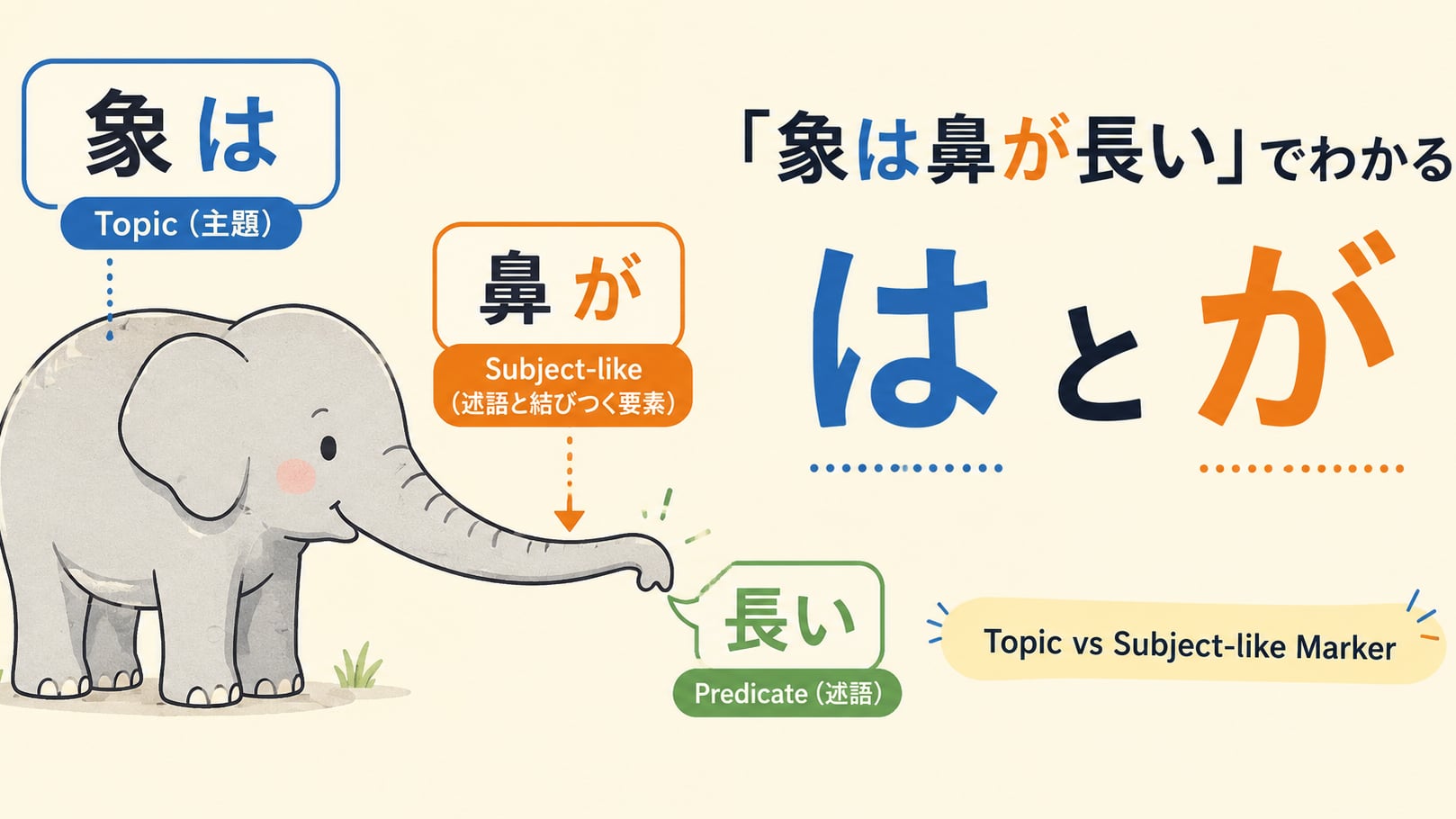
The sentence 象は鼻が長い is close in meaning to "Elephants have long trunks," but Japanese builds the idea differently. 象は introduces the topic ("as for elephants"), and 鼻が長い tells you what is long—the trunk, not the elephant. Treat は as a topic marker and が as the element tied to the predicate, rather than as two competing subject markers.
How Do You Say 象は鼻が長い in English?
In Japanese grammar explanations, 象は鼻が長い is a well-known example sentence. It is also the title of Akira Mikami's Zō wa hana ga nagai — Nihon bunpō nyūmon (1960 first edition). It is a classic illustration of how Japanese can name one thing and then describe a part of it in the same short sentence.
Key words for beginners
If the kanji are still new, start with the three content words below. The particles は and が are explained later; for now, read the sentence as elephants → trunk → long.
- Reading
- zō
- Meaning
- elephant
- Reading
- hana
- Meaning
- nose; trunk (in this sentence)
- Reading
- nagai
- Meaning
- long
| Japanese | Reading | Meaning |
|---|---|---|
| 象 | zō | elephant |
| 鼻 | hana | nose; trunk (in this sentence) |
| 長い | nagai | long |
- 象 (zō) — The animal. You may also see this character in phrases such as 動物園の象 (dōbutsuen no zō, the zoo's elephant).
- 鼻 (hana) — In everyday Japanese this usually means nose, but for elephants English uses trunk. In 象は鼻が長い, 鼻 clearly refers to an elephant's trunk—not a human nose.
- 長い (nagai) — An i-adjective meaning "long." It describes 鼻: the trunk is what is long. Adjectives like 長い can finish a sentence on their own (長い。simply means "It is long.").
AdA classic introductory book on Japanese grammar known for the famous example sentence used in this article.Akira Mikami — Zō wa hana ga nagai (Introduction to Japanese Grammar)
A natural English translation looks like this.
Elephants have long trunks.
That version uses have, which works well in English. Japanese does not need a word like "have" here. Instead, it sets a topic and then states a property of a part.
If you want a translation that stays closer to the Japanese structure, you can think of it like this.
As for elephants, (their) trunks are long.
| Japanese | Natural English | Structure-close English |
|---|---|---|
| 象は鼻が長い。 | Elephants have long trunks. | As for elephants, their trunks are long. |
Neither English version is "wrong." They simply show two ways to express the same idea: one natural for English, one closer to how Japanese lines up its pieces.
What Does は Mark? (Topic, Not Just "Subject")
は is often introduced as a topic marker. In plain terms, it signals: this is what we are talking about now.
When you hear 象は, the sentence is not claiming that "elephant" is the thing that is long. It is saying: we are talking about elephants, and something about them will follow.
This is one reason は is easy to confuse with English "subject." In 象は鼻が長い, 象は can look like a subject, but the adjective 長い (long) does not attach to 象 directly. The long thing is 鼻 (trunk), marked with が.
は Attaches to More Than "Subjects"
は is not limited to people or animals. It can mark a place, situation, or setting as the topic.
- Rough meaning
- In America / as for America, tipping is common.
- Rough meaning
- As for Saitama / when it comes to Saitama, I have never been there.
- Rough meaning
- Please do not run here / in this place.
| Japanese | Rough meaning |
|---|---|
| アメリカでは、チップを払うことが多い。 | In America / as for America, tipping is common. |
| 埼玉には行ったことがない。 | As for Saitama / when it comes to Saitama, I have never been there. |
| ここでは走らないでください。 | Please do not run here / in this place. |
In アメリカでは, は does not turn アメリカ into a grammatical subject of "pay." It frames America as the topic: speaking of America, here is how things tend to work.
📌 For learners, は = topic marker is usually a clearer starting point than は = subject marker.
What Does が Mark? (The Element Tied to the Predicate)
In 鼻が長い, が marks 鼻 (trunk) as the element that pairs with 長い (long). In other words: what is long is the trunk.
That is why a literal-style misreading—"The elephant is long"—does not fit. 長い connects to 鼻, not to 象.
Some textbooks call が a "subject marker." That is not broadly wrong. However, in sentences like 象は鼻が長い, where は and が appear in the same clause, treating both as "subject markers" quickly becomes confusing. A practical learner-level approach is as follows.
- は frames what the sentence is about (topic).
- が marks the noun that the predicate describes in this clause (here: 鼻 + 長い).
In some contexts, が can also highlight which person or thing fits a description—especially in questions or contrasts. This article keeps the main focus on the 象は鼻が長い pattern; finer points about contrast and emphasis belong in later study.
Why Not 象が鼻が長い?
For a neutral statement about a typical feature of elephants, 象は鼻が長い is the natural choice.
象が鼻が長い can be discussed in special contexts—for example, when identifying which animal is meant—but it is not the basic pattern for beginner or intermediate learners. Without a supporting contrast or context, it often sounds odd in everyday explanation. As a first pattern to memorize, master 象は鼻が長い first.
How Is the Whole Sentence Structured?
You can read 象は鼻が長い in three chunks.
象は  /  鼻が  /  長い
Topic /  Noun+が /  Predicate (adjective)
- Role
- Topic
- Learner-friendly gloss
- As for elephants…
- Role
- Element linked to 長い
- Learner-friendly gloss
- …(their) trunks…
- Role
- Predicate
- Learner-friendly gloss
- …are long
| Part | Role | Learner-friendly gloss |
|---|---|---|
| 象は | Topic | As for elephants… |
| 鼻が | Element linked to 長い | …(their) trunks… |
| 長い | Predicate | …are long |
Think of the flow as topic → comment. The comment itself (鼻が長い) has its own internal subject-like element, 鼻, marked with が.
Grammar explanations sometimes describe this pattern as a "double subject" construction. You do not need that label to use the sentence—but it helps explain why two nouns can appear without sounding like "elephants and trunks are both subjects fighting for the same verb."
How Is Japanese Different from English Here?
English often packs possession into have.
- Elephants have long trunks.
- I have poor eyesight. → 私は目が悪い。
Japanese frequently uses AはBがC instead.
- Natural English
- I have poor eyesight. / My eyesight is poor.
- Natural English
- He is tall. (literally: as for him, his height is tall)
- Natural English
- This town has narrow streets.
| Japanese | Natural English |
|---|---|
| 私は目が悪い。 | I have poor eyesight. / My eyesight is poor. |
| 彼は背が高い。 | He is tall. (literally: as for him, his height is tall) |
| この町は道が狭い。 | This town has narrow streets. |
The pattern does not mean Japanese "has no subjects." It means the language often introduces a topic first, then states which part or aspect the predicate applies to.
What Other Sentences Follow the AはBがC Pattern?
Once you recognize the pattern, you will see it often.
- Natural English
- I like coffee.
- Notes
- Classic textbook example
- Natural English
- Food is delicious in Japan.
- Notes
- Topic = Japan; delicious thing = food
- Natural English
- This shop is famous for its ramen.
- Notes
- Natural English
- Summers are hot in Japan.
- Notes
| Japanese | Natural English | Notes |
|---|---|---|
| 私はコーヒーが好きです。 | I like coffee. | Classic textbook example |
| 日本は食べ物がおいしい。 | Food is delicious in Japan. | Topic = Japan; delicious thing = food |
| この店はラーメンが有名です。 | This shop is famous for its ramen. | |
| 日本は夏が暑い。 | Summers are hot in Japan. |
How Is 象の鼻は長い Different from 象は鼻が長い?
Both can describe long elephant trunks, but the topic changes.
- What is the topic?
- Elephants (the animal)
- Nuance
- A general feature of elephants
- What is the topic?
- Elephant trunks
- Nuance
- The trunk itself is what you are talking about
| Sentence | What is the topic? | Nuance |
|---|---|---|
| 象は鼻が長い。 | Elephants (the animal) | A general feature of elephants |
| 象の鼻は長い。 | Elephant trunks | The trunk itself is what you are talking about |
If you are introducing elephants as a species, 象は鼻が長い is the textbook-friendly default.
Frequently Asked Questions
Can you say 象が鼻が長い?
For a neutral, everyday description of elephants, 象は鼻が長い is natural. 象が鼻が長い can be discussed in special identifying contexts, but it is not the basic form for beginner or intermediate learners. As a first pattern to memorize, stick with 象は.
Is は a subject marker?
は often attaches to words that look like subjects, but it marks topic, not grammatical role alone. It can also attach to places and settings (アメリカでは, ここでは). Treating は only as "subject" makes sentences like 象は鼻が長い harder to parse.
Is が a subject marker?
が often marks the noun that pairs with the predicate—鼻が長い, 雨が降る, 猫がいる. Calling it a "subject marker" is a useful shortcut, but in AはBがC sentences it is clearer to think of は as topic and が as marking the element inside the comment that connects to the adjective or verb.
Why doesn't 象は鼻が長い mean "The elephant is long"?
Because 長い attaches to 鼻, not 象. 象は sets the frame; 鼻が長い states what is long. Natural English uses "have" or "their trunks are long" rather than "the elephant is long."
Does Japanese have no subject?
It is more accurate to say Japanese and English organize information differently. Topics, omitted pronouns, and predicates on body parts or features are normal in Japanese. That is not the same as "no subject."
What Should You Practice Next?
- Listen for AはBがC in daily speech: 暑い, 好き, 有名, 高い, and 狭い appear constantly.
- Compare は and が in minimal pairs: 象は鼻が長い vs 象の鼻は長い.
- Do not force English "have" into every Japanese sentence—notice when Japanese uses が with adjectives instead.
- When you are ready for follow-up topics, look for articles on 僕はウナギだ-style sentences and こんにゃくは太らない-style context (planned as separate guides).
Related Articles
Sources
- Tofugu — は and が: What's the Difference, Really? (accessed June 17, 2026)
- Tofugu — Particle は: Topic Marker (accessed June 17, 2026)
- Tofugu — Particle が: Subject Marker (accessed June 17, 2026)
- Kuroshio Publishers — Akira Mikami, Zō wa hana ga nagai — Nihon bunpō nyūmon (reprint notice) (accessed June 17, 2026)
- Shio Publishing — Shigeaki Toyama, Wasureru chikara (includes the chapter "象は鼻が長い") (accessed June 17, 2026)
- Gunma University — Yamada, "On the Multiple Subject Construction in Japanese: A Cartographic Approach" (2013) (accessed June 17, 2026)