


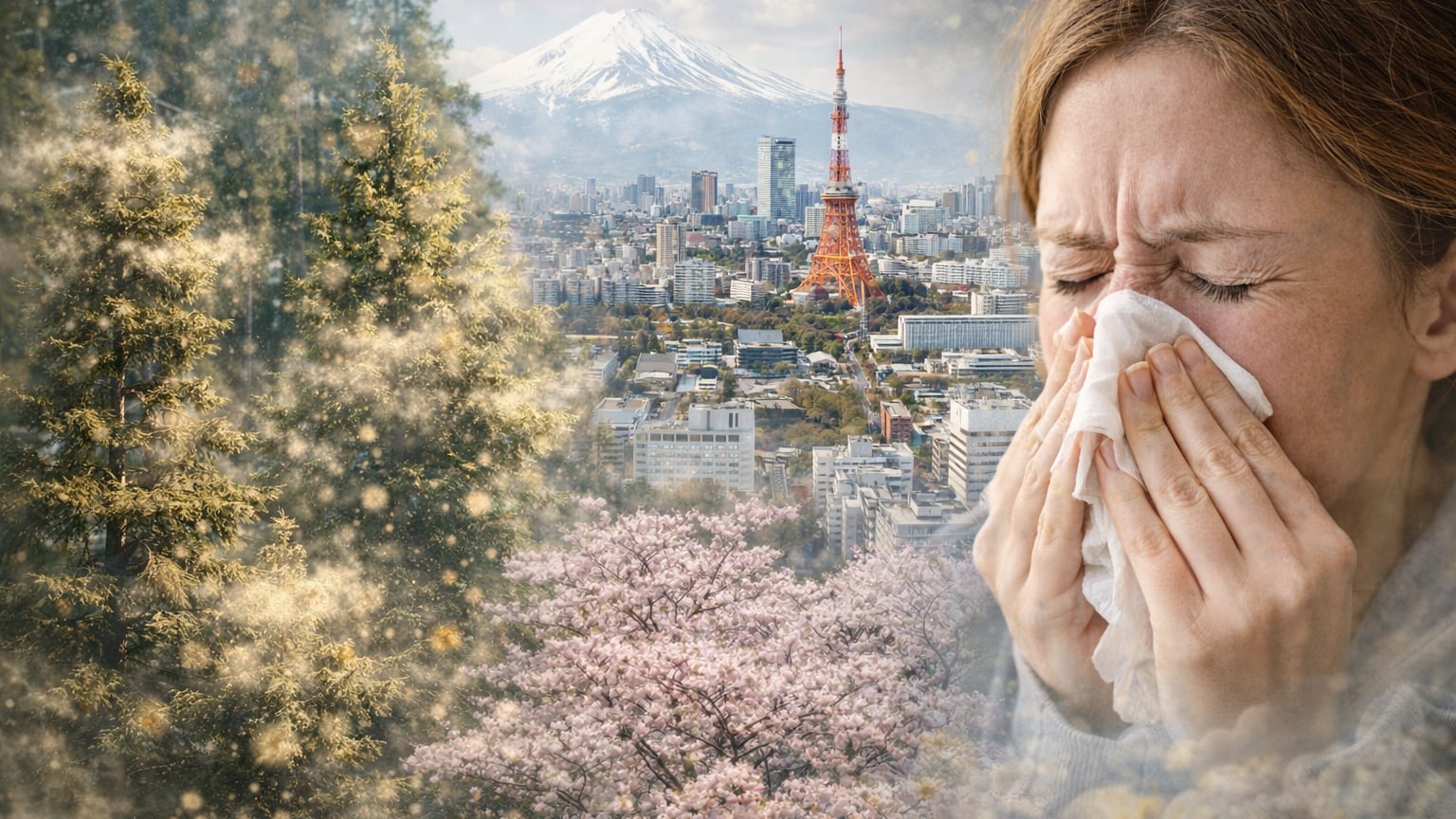

Hay fever (kafunsho) is an allergy where your immune system overreacts to pollen — causing sneezing, runny nose, and itchy eyes. In Japan, many people develop it for the first time after arriving. This article covers how hay fever works, common symptoms, how to tell it from a cold, when to see a doctor, and Japanese medical terms you'll need.
What's Actually Happening in Your Body?
Hay fever is an allergic reaction where your immune system mistakes pollen for an invader and overreacts.
Not all plant pollen causes hay fever, though. The main culprits are wind-pollinated plants — species that rely on the wind to spread their pollen. In Japan, Japanese cedar (sugi) and Japanese cypress (hinoki) are the biggest offenders. These trees were planted on a massive scale after World War II for timber, and now that they've matured, they release enormous amounts of pollen every year. Grasses (such as rice paddy plants) and ragweed also cause hay fever. Insect-pollinated flowers like roses and tulips rarely cause hay fever because their pollen doesn't float through the air in large quantities.
When pollen lands on the mucous membranes of your nose or eyes, your body produces IgE antibodies. These antibodies trigger the release of histamine and other chemicals, causing sneezing, runny nose, and itchy eyes.
📌 Pollen itself isn't harmful — it's your immune system's overreaction that causes the symptoms. Even if you've never had hay fever before, you can develop it after living in Japan. Repeated exposure to pollen causes antibodies to accumulate in your body until they reach a tipping point, and symptoms suddenly begin.
I live in Japan and have hay fever from cedar (sugi) and rice (ine) pollen. From mid-February through mid-April, my sneezing, runny nose, and itchy eyes are at their worst — it's a rough stretch every year.
What Are the Common Symptoms?
Symptoms vary from person to person, but here are the most common ones.
- Symptoms
- Repeated sneezing, constant clear and watery runny nose, nasal congestion
- Symptoms
- Itchiness, redness, watery eyes
- Symptoms
- Itchiness, scratchy feeling
- Symptoms
- Itchiness, redness, dryness (pollen dermatitis)
- Symptoms
- Fatigue, brain fog, difficulty concentrating
| Area | Symptoms |
|---|---|
| 👃 Nose | Repeated sneezing, constant clear and watery runny nose, nasal congestion |
| 👁️ Eyes | Itchiness, redness, watery eyes |
| 🗣️ Throat | Itchiness, scratchy feeling |
| 🫠 Skin | Itchiness, redness, dryness (pollen dermatitis) |
| 😴 Whole body | Fatigue, brain fog, difficulty concentrating |
📌 Symptoms tend to worsen on days with high pollen counts. Getting into the habit of checking pollen forecasts in the weather report helps you prepare in advance.
AdAntihistamine eye drops for itch and redness.Rohto Alguard Clear Block Z 13mL (OTC eye drops)
How Can You Tell Hay Fever from a Cold?
You might think "I have a runny nose and sneezing, so it must be a cold," but there are several differences between hay fever and a cold.
- Hay fever
- Clear and watery
- Cold
- Starts clear, then turns yellow/green
- Hay fever
- Comes in rapid bursts
- Cold
- Occasional
- Hay fever
- ✅ Strong itchiness
- Cold
- ❌ Rarely
- Hay fever
- ❌ Generally none
- Cold
- ✅ Often 37.5°C+
- Hay fever
- Lasts throughout pollen season
- Cold
- Clears up in 1–2 weeks
- Hay fever
- Worse in the morning or after going outside
- Cold
- Roughly the same all day
| What to check | Hay fever | Cold |
|---|---|---|
| Runny nose | Clear and watery | Starts clear, then turns yellow/green |
| Sneezing | Comes in rapid bursts | Occasional |
| Itchy eyes | ✅ Strong itchiness | ❌ Rarely |
| Fever | ❌ Generally none | ✅ Often 37.5°C+ |
| Duration | Lasts throughout pollen season | Clears up in 1–2 weeks |
| Time of day | Worse in the morning or after going outside | Roughly the same all day |
📌 Itchy eyes are the easiest way to tell. If your eyes are itchy and your runny nose is clear and watery, hay fever is very likely.
When Should You See a Doctor?
Consider seeing a doctor early if any of the following apply to you:
- ✅ OTC medication hasn't helped after a few days
- ✅ Symptoms are severe enough to interfere with daily life or work
- ✅ Nasal congestion keeps you from sleeping at night
- ✅ You're experiencing these symptoms for the first time and aren't sure if it's hay fever
⏰ Ideally, visit a doctor 2–4 weeks before pollen season starts. In Honshu, cedar pollen can begin as early as early February, so seeing a doctor in January is ideal. Starting medication before the season — called "initial therapy" (shoki ryoho) — can help keep symptoms milder. For details on timing and regional differences, see Why Japan's Pollen Is So Bad.
For a guide on visiting hospitals in Japan, see Navigating Hospitals in Japan.
What Japanese Do You Need for Hay Fever?
Here are key terms you'll encounter at hospitals and pharmacies. Simply saying "kafunsho da to omoimasu" (I think I have hay fever) is enough to point the doctor in the right direction.
| Japanese | Reading | Meaning |
|---|---|---|
| 花粉症 | kafunsho | Hay fever / Pollen allergy |
| アレルギー科 | arerugi-ka | Allergy department |
| 耳鼻咽喉科 | jibi-inko-ka | ENT (Ear, Nose, Throat) |
| 内科 | naika | Internal medicine |
| 眼科 | ganka | Eye clinic |
| 抗ヒスタミン薬 | ko-hisutamin-yaku | Antihistamine |
| 点鼻薬 | tenbi-yaku | Nasal spray |
| 目薬 | megusuri | Eye drops |
| 鼻水 | hanamizu | Runny nose |
| くしゃみ | kushami | Sneeze |
| 処方箋 | shohosen | Prescription |
FAQ
Can hay fever develop suddenly?
Yes — it can appear out of nowhere. Repeated exposure to pollen causes IgE antibodies to build up in your body, and once they pass a certain threshold, symptoms begin. "I was fine last year but this year it hit me" is a very common story. Many foreigners develop hay fever for the first time after coming to Japan.
Can hay fever be cured?
A complete cure is difficult at this point, but symptoms can be very effectively controlled. Medication provides significant relief, and there's a long-term treatment called sublingual immunotherapy (zekka men'eki ryoho). However, it requires 3–5 years of consistent treatment and results vary. Consult an ENT or allergy specialist for details.
Is wearing a mask enough?
A mask alone isn't sufficient. Masks help block pollen from entering your nose and mouth, but they don't help with itchy eyes. Combining a mask with pollen-blocking glasses and/or medication is much more effective.
AdBlock pollen and PM2.5 with a snug-fit mask.Comfort Premium Mask Small (PM2.5, 200 sheets)
AdPollen glasses that cover around the eyes. JIS certified.Yamamoto Kogaku LF-240G Protective Glasses (Anti-fog, UV)
For a prioritized list of countermeasures, see the Hay Fever Survival Guide.
Action Steps
- ✅ If you have runny nose, itchy eyes, or sneezing, use the "Hay Fever vs. Cold" table above for a self-check
- ✅ If hay fever is likely, try an OTC antihistamine (Allegra, Claritin, etc.) from a drugstore first
- ✅ If OTC medication doesn't help, book an appointment at an ENT or allergy clinic
- ✅ Read Why Japan's Pollen Is So Bad to understand timing and regional trends