
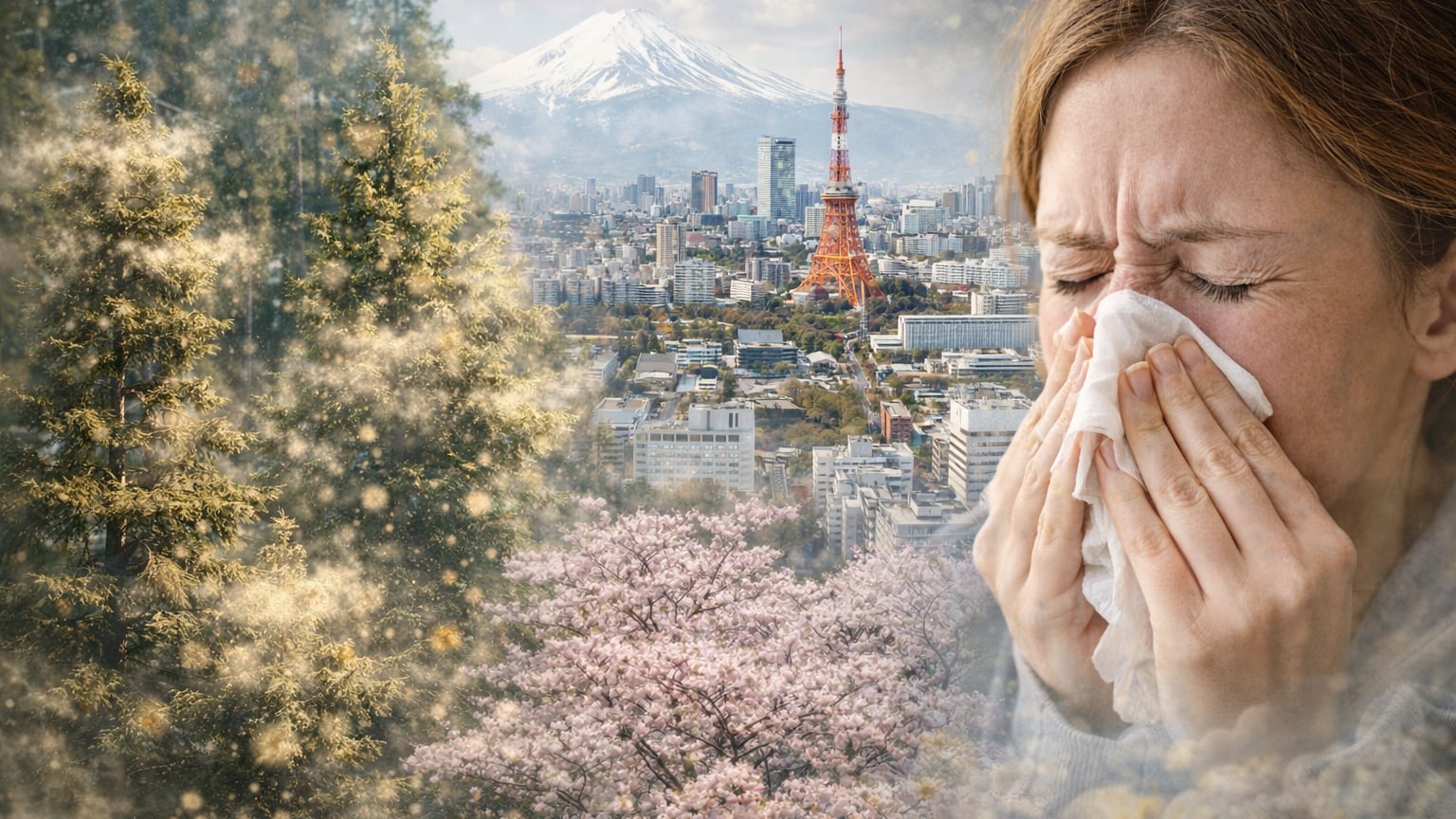



Japan's hay fever is severe because cedar and cypress trees planted after World War II now release enormous pollen every spring. In Honshu, the season can start in early February and peaks in March–April. This article explains why, and when and where to be most careful.
For the basics on how hay fever works and its symptoms, start with What Is Hay Fever?.
When Does Pollen Season Start?
Japan's pollen season starts earlier than most people expect.
⏰ Depending on the region, cedar pollen typically begins in early to mid-February in Honshu. In Kyushu, it can start even earlier — late January in some years. In Hokkaido, there's almost no cedar, but birch pollen flies from April through June.
📌 The exact start date can shift by one to two weeks from year to year. Always check that year's pollen forecast for the latest information.
Why Are Cedar and Cypress the Main Culprits?
The main causes of hay fever in Japan are Japanese cedar (sugi) and Japanese cypress (hinoki) pollen.
- Typical season
- Around Feb–Apr
- Key facts
- The #1 cause of hay fever in Japan. Accounts for about 18% of Japan's forest area
- Typical season
- Around Mar–May
- Key facts
- Season overlaps with and extends beyond cedar. Cross-reacts with cedar pollen
| Tree | Typical season | Key facts |
|---|---|---|
| Cedar (sugi) | Around Feb–Apr | The #1 cause of hay fever in Japan. Accounts for about 18% of Japan's forest area |
| Cypress (hinoki) | Around Mar–May | Season overlaps with and extends beyond cedar. Cross-reacts with cedar pollen |
Because their seasons overlap, many people experience a "double punch" — just when they think cedar season is over, cypress kicks in.
In my case, cypress pollen is especially brutal. Late March through April is the toughest stretch of the year. Cedar alone is manageable, but once cypress joins in, symptoms ramp up dramatically.
What Does Post-War Reforestation Have to Do with It?
There's a historical reason Japan has so much cedar.
After World War II, Japan needed timber for reconstruction. According to the Forestry Agency, massive cedar and cypress plantations were established across the country from the 1950s through the 1970s. These trees have now matured and produce huge quantities of pollen.
Meanwhile, cheap imported timber reduced demand for domestic wood, so these forests haven't been logged or replanted. The result: mature man-made forests blanketing the country and pumping out pollen.
📌 The Japanese government is working on countermeasures, including replacing trees with low-pollen varieties. However, updating an entire nation's forests takes a very long time, so a significant reduction in pollen levels is unlikely in the near term.
Are There Regional Differences?
Pollen levels and timing do vary by region. Keep in mind that these are general tendencies — actual conditions depend on the year and weather.
- Tendency
- Tends to receive more pollen blown from nearby mountains where cedar and cypress grow
- Tendency
- Pollen that lands on concrete and asphalt gets kicked back into the air, making symptoms feel worse
- Tendency
- Tends to have somewhat lower pollen counts than the Pacific side, though timing is similar
- Tendency
- Almost no cedar — cedar hay fever is rare here. Watch out for birch pollen (Apr–Jun) instead
- Tendency
- Virtually no cedar or cypress — hay fever risk is very low
| Region | Tendency |
|---|---|
| Pacific side (Tokyo, Osaka, etc.) | Tends to receive more pollen blown from nearby mountains where cedar and cypress grow |
| Urban areas | Pollen that lands on concrete and asphalt gets kicked back into the air, making symptoms feel worse |
| Sea of Japan side | Tends to have somewhat lower pollen counts than the Pacific side, though timing is similar |
| Hokkaido | Almost no cedar — cedar hay fever is rare here. Watch out for birch pollen (Apr–Jun) instead |
| Okinawa | Virtually no cedar or cypress — hay fever risk is very low |
📌 Some people dream of moving to a "low-pollen area," but even in Hokkaido or Okinawa, other allergens (grass pollen, ragweed, etc.) are possible.
How Do Travelers Get Caught Off Guard?
Travelers who've never experienced hay fever back home sometimes get blindsided in Japan.
❌ Common scenario: Visit Tokyo/Kanto during cherry blossom season (March–April) → Sudden runny nose and itchy eyes → Assume it's a cold and do nothing → Miserable for the entire trip
Cherry blossom season and peak pollen season overlap, so tourists spending long hours outdoors are especially vulnerable.
✅ What you can do beforehand:
- If you're traveling to Japan in spring, bring a mask and eye drops just in case
- If you have a history of hay fever, consult your doctor before departure and get medication
- If symptoms appear after arriving in Japan, look for products labeled "花粉症" (kafunsho) at a drugstore
AdBlock pollen and PM2.5 with a snug-fit mask.Comfort Premium Mask Small (PM2.5, 200 sheets)
AdAntihistamine eye drops for itch and redness.Rohto Alguard Clear Block Z 13mL (OTC eye drops)
For detailed information on countermeasures and how to visit a hospital, see the Hay Fever Survival Guide.
Does Pollen Vary Year to Year?
Yes — pollen levels fluctuate significantly from year to year.
The previous summer's temperature, sunshine hours, and rainfall affect how many pollen-producing buds cedar and cypress trees form. A hot summer tends to mean more pollen the following spring. However, actual dispersal also depends on that season's weather (temperature, wind, rain), so accurate predictions aren't available until right before the season.
📌 Every January–February, weather services and the Ministry of the Environment release pollen forecasts. Checking that year's forecast is the most reliable way to know what to expect.
- Ministry of the Environment — Pollen Observation System (Hanako-san)
- Japan Meteorological Association — Pollen Forecast
FAQ
Where in Japan has less pollen?
Hokkaido and Okinawa have almost no cedar or cypress, so cedar-related hay fever is much less of an issue. However, Hokkaido has birch pollen (around April–June), and even Okinawa has some grass pollen — zero allergens is never guaranteed.
Which month is the worst?
It depends on the region, but in Honshu, March is typically peak cedar season, and cypress joins in around April for a double punch. In my experience, late March through early April is the most brutal stretch. Keep in mind that pollen levels vary year to year, so check the season's forecast.
Is it better on rainy days?
Generally, yes — rain reduces airborne pollen, so symptoms tend to ease up. However, be careful on sunny days after rain. Pollen that was washed to the ground dries out and gets kicked back up, causing a sudden spike in pollen counts.
Action Steps
- ✅ Check whether your time in Japan overlaps with cedar/cypress season using the table above
- ✅ Bookmark pollen forecast sites (Hanako-san, tenki.jp)
- ✅ If traveling to Japan in spring, prepare a mask and eye drops in advance
- ✅ For practical countermeasures, see the Hay Fever Survival Guide